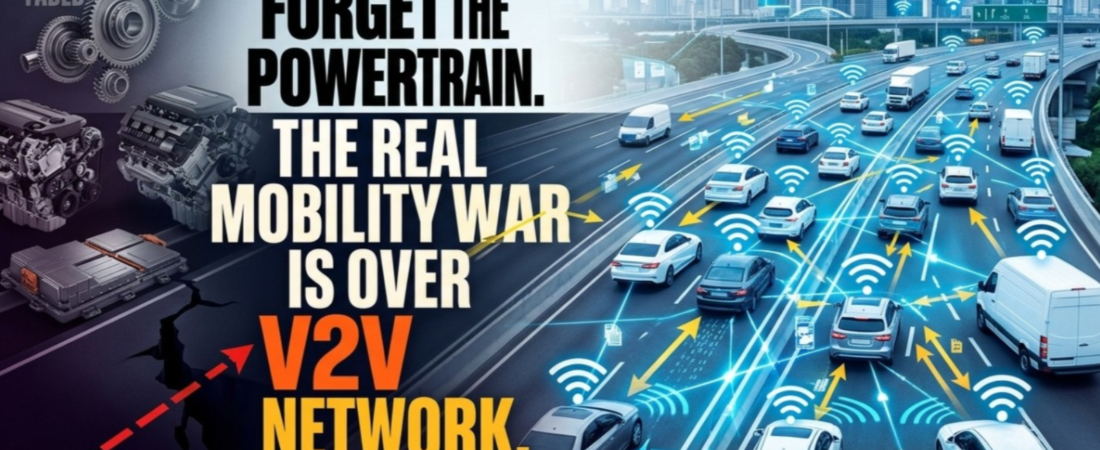
The Indian government’s proposed mandate requiring Vehicle-to-Vehicle (V2V) communication in all new vehicles by October 2028 is not an ordinary safety update. It is a high-stakes, forced evolution of the entire auto industry.
For decades, car makers fought for market dominance using metal, horsepower, and visual styling. That playbook is dead. The future will be won by whoever controls the real-time software network connecting every machine on the road.
The Fatal Flaw of Modern Car Safety
Right now, vehicle safety relies almost entirely on isolated hardware—cameras, radar, and human reflexes.
They all share the same fatal flaw: they need a direct line of sight.
If a truck slams on its brakes around a sharp, foggy corner, your radar can’t see through the mountain. Your camera can’t see through the fog. You react only after you see the threat—often too late.
V2V changes the physics of road safety. Operating on dedicated 5.9 GHz radio frequencies, equipped vehicles constantly talk to every other vehicle around them ten times a second. They broadcast live data: exact speed, direction, braking pressure, and hazard alerts.
Comparative Safety Approach is as follows:
a) Visibility
Ø Cameras & Radar (Isolated): Line-of Sight Only
Ø V2V Communication (Networked): Non-line-of-sight (See around bends, through fog, past trucks)
b) Response Speed
Ø Cameras & Radar (Isolated): Reactive (Responds after danger appears)
Ø V2V Communication (Networked): Predictive (Warns before danger is visible)
c) Failure Point
Ø Cameras & Radar (Isolated): Blocked by rain, dirt or obstacles
Ø V2V Communication (Networked): Continuous, 360-degree wireless cross-check
d) Core Advantage
Ø Cameras & Radar (Isolated): Reduce crash damage
Ø V2V Communication (Networked): Eliminates the crash entirely
What This Means for Auto Executives
This is no longer a conversation about making better cars. It is a battle over who controls the digital ecosystem.
– Hardware is a Commodity; Software is the Moat
Building a strong chassis is no longer enough. Under the new AIS-230 standards, every vehicle must act as a secure, low-latency data node. If your software architecture cannot handle instant, real-time data processing, your vehicles will be obsolete on arrival.
– The Cyber security Nightmares Are Real
When vehicles continuously talk to each other, a cyber breach isn’t just a data leak—it’s a physical security crisis. Auto manufacturers must transform into top-tier cyber security operations to protect kinetic endpoints on public roads.
– The Supply Chain Realignment
The real leverage in the market is shifting from traditional engine component suppliers to chip makers, wireless platform providers, and software engineers (think Qualcomm, Bosch, and Continental).
The Hard Truth: The 2028 deadline is non-negotiable.
The auto industry spent over a century competing on engine power. The next decade will be brutally decided by network power.
The leaders who treat V2V as merely a regulatory check box will be reduced to contract hardware builders. The leaders who build the underlying software, connectivity, and data infrastructure today will own the future of mobility.
The choice is simple: build the network, or become irrelevant.
Do share your opinion here.
#Automotive #manufacturing #Technology #Business Strategy #Leadership