One data point from May 2026 should have every boardroom in the Indian automotive sector re-examining its five-year plan.
One in three passenger vehicles sold in India last month ran on something other than conventional petrol or diesel.
Not one in ten. Not one in five. One in three.
This isn’t a product trend. It’s a tectonic psychological shift. And the leaders who are still building strategies around brand emotion, aspirational advertising, and feature laddering are solving the wrong problem entirely.
The 500-Basis-Point Evacuation Nobody Is Talking About
In a single year, the combined market share of conventional petrol and diesel passenger vehicles dropped from 72.9% to 67.9% — a 500-basis-point swing in twelve months.
In a market as large and as entrenched as India’s, that is not a fluctuation. That is a structural exodus.
Alternative fuel vehicles — CNG, EVs, and strong hybrids combined — now command 32.1% of all passenger vehicle sales. If your product portfolio is still heavily weighted toward standard ICE variants, your serviceable addressable market is contracting in real time, every month, with mathematical precision.
Math Wins. Hype Loses. Every Time.
Here is where the story gets even more instructive for strategy leaders.
The segment that dominated this shift? Not the gleaming EV with a 450km range. Not the status-signalling strong hybrid with a tri-motor drivetrain.
It was the factory-fitted CNG car.
CNG vehicles alone accounted for 23.5% of total passenger vehicle sales. Pure passenger EVs sat at 6.6%. Strong hybrids, despite years of premium marketing investment, slipped to just 2%.
Why? Because Indian consumers are not buying technology. They are buying arithmetic.
A factory-fitted CNG vehicle costs approximately ₹90,000 more than its petrol equivalent. The payback period at current fuel prices is under 18 months for a typical urban commuter. That is a math problem with a clear answer.
A strong hybrid demands a premium of ₹3 lakh to ₹4 lakh — driven partly by complex powertrain architecture and heavily by import dependency on battery packs. The payback arithmetic is significantly murkier. For a value-conscious consumer operating in a high-inflation, high-interest-rate environment, murky arithmetic is a dealbreaker.
The lesson for executives is unambiguous: Affordability of adoption beats sophistication of technology. Every single time.
The Real EV Revolution Is Happening on Two Wheels
While the industry obsesses over passenger car EV penetration, the actual revolution is rolling past on two wheels.
The electric two-wheeler segment is the force that has pushed India’s overall domestic EV penetration to an all-time high of 10.7%.
This price-sensitive, high-frequency, high-volume segment did not need infrastructure subsidies to reach critical mass. It needed economics that worked. When the total cost of ownership made sense, adoption happened fast — almost overnight.
That is the proof of concept every OEM and every board needs to internalize: Indian consumers are not EV-resistant. They are friction resistant. Remove the economic friction, and the adoption curve bends sharply upward.
The Mandate: Stop Chasing the Technology Narrative
The compounding pressure on this market will not ease. West Asia volatility continues to create input cost uncertainty for automakers. Crude price shocks pass through to petrol and diesel pump prices with speed. Every rupee increase at the pump accelerates the consumer’s flight toward operating cost certainty.
Automakers cannot simply pass higher manufacturing costs onto a buyer who is already making decisions based on a five-year fuel cost projection.
This creates a specific, urgent mandate for the leaders in the Automobile Industry:
Portfolios with petrol-centric or diesel-heavy weightings are entering a structural headwind. Not a cyclical one. A structural one. The consumer has already voted with their purchase order. They will not be voted back.
The leaders who will win this decade are those who stop asking “How do we make our EVs more exciting?” and start asking “How do we engineer absolute affordability into alternative powertrains at scale?”
That is a manufacturing question. A supply chain question. A platform architecture question. It is not a marketing question.
The Question for Your Board
If rising input costs — from West Asia uncertainty, from import-dependent battery components, from supply chain realignment — are compressing your margins, and a value-driven consumer refuses to absorb those costs in the sticker price, where does your business model absorb the delta?
That is the uncomfortable question sitting at the centre of every auto industry strategy review right now.
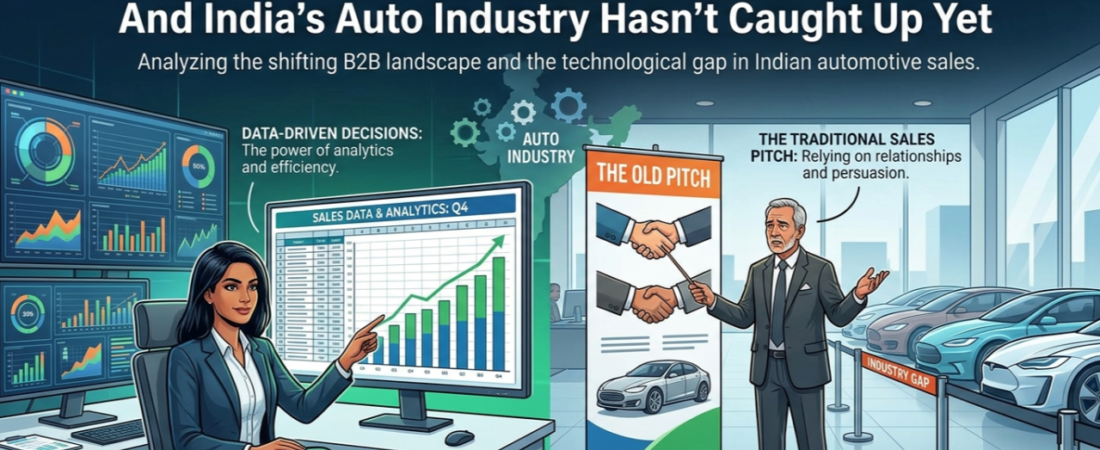
The spreadsheet has replaced the sales pitch.
Is your portfolio built for the consumer who is doing the math?
How is your board balancing rising manufacturing costs against the consumer’s demand for unyielding operating economics?
I’d like to hear how you in this space are approaching it.
#AutomotiveIndustry #MobilityTransition #EV #CNG #BusinessStrategy #CSuiteLeadership #IndiaAuto #FutureOfMobility #ManufacturingStrategy #TotalCostOfOwnership