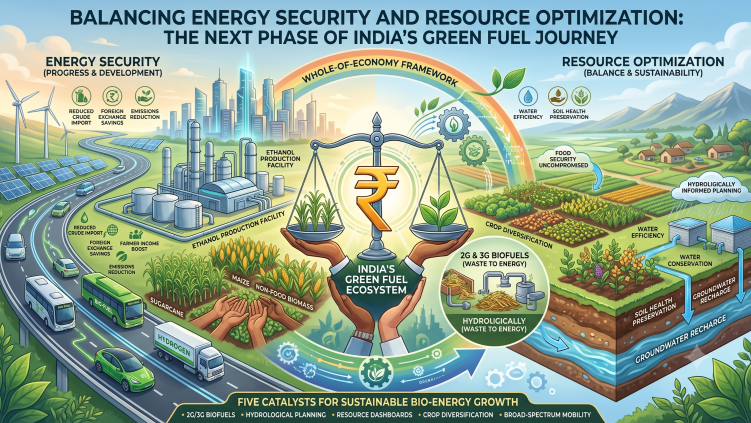
India’s ethanol-blending program stands as one of the country’s most decisive policy achievements. Reaching major blending milestones has delivered tangible economic and environmental dividends:
- Foreign Exchange Savings: Substantial reduction in crude oil import dependency.
- Farmer Value Creation: Direct, stable revenue streams for agricultural producers.
- Emissions Reduction: Measurable decarbonization of the transport sector.
- Rural Industrialization: Accelerated investments in bio-refineries and rural infrastructure.
As India successfully approaches E20 adoption, industry leaders, economists, and planners are naturally asking the next strategic question: How does India scale its bio-energy ambitions while maintaining long-term food, water, and agricultural equilibrium?
Sustainable leadership is not about slowing progress—it is about planning the next phase with total resource harmony.
The Integrated Resource Equation: Food, Water, and Energy
Every robust national strategy evolves by balancing multiple interconnected assets: arable land, groundwater tables, energy demand, and food supplies.
+——————————————————————————-+
| THE BIO-ENERGY BALANCING MATRIX |
+——————————————————————————-+
| Strategic Asset | Primary Goal | Interdependent Factor |
+———————+————————-+——————————-+
| Energy Independence | Lower crude import bill | Feedstock availability |
| Water Conservation | Groundwater recharge | Crop water intensity (1G) |
| Food Security | Stable food inflation | Acreage for oilseeds & pulses |
| Tech Innovation | High-value exports | 2G Biofuels & EV Ecosystems |
+——————————————————————————-+
Global experience shows that as biofuel blends scale, resource planning must expand from a single-sector focus to a whole-of-economy framework:
- Global Lessons: Both the U.S. and Brazil demonstrated that scaling crop-based biofuels requires constant calibration to ensure domestic crop diversification and stable food markets remain intact.
- Hydrological Considerations: Water-intensive agricultural belts require localized groundwater budgeting to ensure long-term soil productivity and aquifer resilience.
- Crop Diversification: Ensuring balanced incentives preserves acreage for vital domestic crops like oilseeds and pulses, keeping overall agricultural import bills optimized.
Strategic Pathway: Five Catalysts for Sustainable Bio-Energy Growth
To maintain momentum while safeguarding ecological capital, India’s green fuel roadmap can integrate five strategic pillars:
- Prioritize 2G and 3G Biofuels: Accelerate fiscal incentives and infrastructure for second-generation ethanol utilizing agricultural residue (paddy straw, bagasse) and municipal organic waste, completely decoupling fuel production from food crops.
- Hydrologically Informed Planning: Calibrate 1G feedstock expansion incentives according to regional groundwater tables, encouraging ethanol crop production in water-surplus basins rather than overstressed aquifers.
- Integrated Resource Dashboards: Deploy data-driven dashboards tracking the Food-Water-Energy Nexus to ensure ethanol targets support broader agricultural sustainability.
- Support Crop Diversification: Align agricultural procurement incentives so that pulses, oilseeds, and climate-resilient millets remain equally lucrative for farmers.
- Broad-Spectrum Mobility Leadership: Pair biofuel expansion with ongoing investments in electric mobility platforms, battery chemistry, hydrogen research, and automotive software exports.
Moving from Expansion to Optimization
Phase 1 of India’s ethanol revolution proved that ambitious targets can be executed with speed and scale.
Phase 2 offers the opportunity to set a global benchmark for circular, resource-optimized energy policy—one that simultaneously delivers energy sovereignty, water conservation, and agricultural resilience.
#EnergyTransition #SustainableDevelopment #AgriTech #ResourceManagement #IndianEconomy #PublicPolicy #GreenMobility #ThoughtLeadership