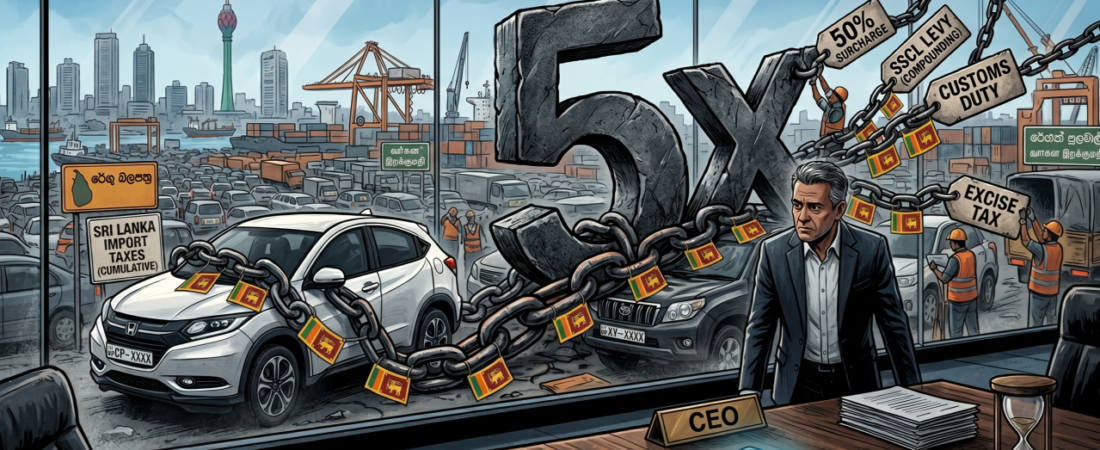
If you are a CEO or business owner in Sri Lanka waiting for the vehicle market to “go back to normal,” you are risking your balance sheet.
The policy shifts from May 2026 are not just another round of high taxes. They represent a permanent structural shift. When landing a vehicle costs three to five times its original price in Japan, it’s no longer a procurement issue. It is a boardroom crisis.
Here is the brutal reality our industry faces right now:
1. The Import Stranglehold
The new 50% import duty surcharge doesn’t exist in a vacuum. Layered on top of the newly applied 2.5% Social Security Contribution Levy (SSCL)—which is collected upfront by Customs on a compounding basis—the math is devastating.
- A standard fleet hybrid like a Honda Vezel is jumping by LKR 1.7 to 1.8 million.
- A Toyota Prado is spiking by up to LKR 4 million.
2. The Automobile Industry Collapse
This is an existential threat to the automotive sector. Dealerships, importers, and service centers are looking at frozen inventory and a complete drying up of consumer demand. To make matters worse, in July, the SSCL threshold drops to Rs. 36 million. This will pull your mid-sized logistics, maintenance, and service partners directly into the tax net, driving up operational costs across your entire supply chain.
The New Bottom Line
With Octane-95 hovering around LKR 495 per litre, fuel efficiency isn’t a “green option” to brag about in your annual sustainability report—it’s an operational shield.
The only remaining loophole is the 2026 Luxury Tax framework, which favors Hybrids and EVs (allowing up to LKR 6.0 million for electrics). Moving your fleet toward high-efficiency Japanese hybrids or EVs is no longer a progressive choice; it is a baseline fiscal necessity.
The Mandate:
Stop treating this as a temporary hurdle. “Temporary” import restrictions under IMF guidelines have a habit of sticking around.
Ask your team today: Are we still budgeting with outdated models, or are we actively re-engineering our logistics for a high-tax, high-efficiency future?
The leaders who restructure their corporate mobility right now are the ones who will protect their margins in 2026.
How is your organization adjusting? Let’s discuss below.
#SriLankaBusiness #AutomotiveIndustry #EconomicOutlook2026 #Strategy #FiscalPolicy