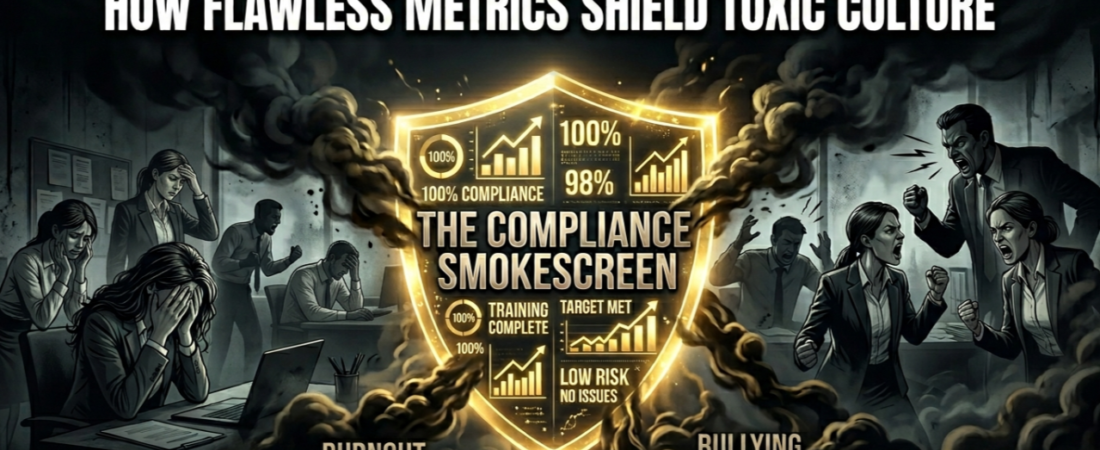
We spend millions on corporate governance. We write beautiful vision statements, build compliance frameworks, and run annual 360-degree feedback surveys.
Yet, some of the worst corporate failures—and the deepest stagnation—happen in organizations that look perfectly healthy on paper.
Why? Because leadership treats governance as a data checklist instead of an active culture. Groundbreaking research from the Indian School of Business (ISB) outlines three types of culture that explain why legacy organizations stall:
1. The Compliance Culture (The “Tick-Box” Trap)
In these environments, meeting standards is done in form, not substance. Leadership runs feedback surveys and summarizes everything into statistical averages.
But averages hide the truth. When you average out the data, you flatten the outliers. The single, courageous voice pointing out that a closed inner circle is monopolizing high-stakes portfolios or sidelining top talent gets buried under a mountain of compliant data points.
2. The Defensive Culture (Protecting the “Club”)
When short-term comfort and politics are prioritized over ethics, a defensive culture takes root. Employees quickly learn the golden rule: Do what pleases management and protect yourself if something backfires.
This leads to two toxic executive habits:
- Over-Reporting: People flood the system with data just to protect themselves (“I reported it, so it’s not my fault”), knowing senior bosses don’t have the time to process it.
- Committee Decisions: Critical promotions and resource allocations are made by closed loops. If a decision fails, everyone is responsible—which means nobody is held accountable.
3. The Cognitive Culture (Connecting the Dots)
Truly sustainable organizations work differently. They build a cognitive culture where everyone understands their role to speak up, and leadership has the courage to act on what they hear.
Moving your organization to this level requires three bold actions:
- Stop Aggregating Feedback: High-impact feedback is not a volume game. One critical outlier voice often holds more truth than a hundred polite, status-quo responses.
- Neutralize the “Repel Effect”: Upward feedback must have a direct, sanitized pipeline to independent decision-makers completely outside the immediate political hierarchy.
- Connect the Dots: Deep-rooted cronyism rarely leaves a blatant paper trail for a traditional whistleblower policy to catch. True accountability requires leaders who look at long-term patterns—who is consistently protected, who gets the premier portfolios, and whose inputs are systematically ignored.
The Bottom Line
If our governance relies on statistical averages and rigid checklists, we are missing the systemic rot right in front of us. True meritocracy requires the institutional honesty to protect the single voice of dissent, look past the graphs, and choose capability over comfort.
How is your board ensuring your culture isn’t just a piece of paper?
#Leadership #CorporateGovernance #RiskCulture #Meritocracy #DiversityAndInclusion