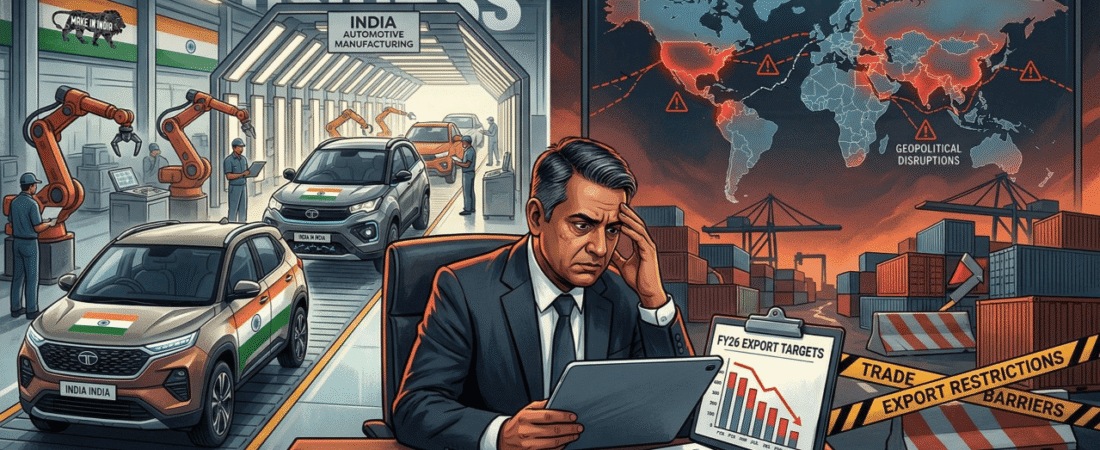
As we enter the final month of the fiscal year, most leadership teams are executing the “closing sprint”—maximizing production and ensuring every unit is invoiced to hit annual revenue targets.
But this year, the sprint has been replaced by a scramble.
While industry sentiment claims we are “de-risked” and “diversified,” the ground reality in the Persian Gulf tells a different story. As we sit here in March 2026, geopolitical tension has ceased to be just a geopolitical headline—it has become a direct, structural, and expensive disruption to the Indian automotive P&L.
The “Just-in-Time” Illusion is Breaking. For years, we’ve prided ourselves on lean, highly efficient supply chains. The current crisis at the Strait of Hormuz has exposed the fragility of that efficiency.
Vessels are stuck, rerouted, or stalling. When your “diversified” strategy relies on maritime arteries that are essentially no-go zones, the result is simple: Inventory is tied up at sea, and revenue is tied up in uncertainty.
The March 31st Whiplash This is the most critical factor that the Auto market, India—and perhaps some leadership teams—are failing to price in: Timing.
- Revenue Recognition: We are in March. An 18-day delay due to rerouting isn’t just a logistical hiccup; it’s a fiscal catastrophe. If those vehicles don’t cross the finish line by the 31st, that revenue doesn’t count for FY26. It slips. Your Q4 numbers, your annual growth, and your EPS targets are all taking a hit in real-time.
- Margin Erosion: Between surging war-risk insurance premiums and the emergency surcharges being levied by shipping lines, the profitability of every exported unit is being crushed.
- The Energy Feedback Loop: As Brent crude spikes toward the $100/barrel mark, the cost of manufacturing is soaring. We are being squeezed on both ends: higher input costs at home and stalled realizations abroad.
Moving Beyond the “Diversified” Narrative It’s time to stop hiding behind the word “diversified.” Having export destinations in more than 100 countries doesn’t help if your primary shipping corridors are compromised.
As leaders, we need to stop treating geopolitical instability as an “external factor.” It is now an internal operational variable.
The storm in the Persian Gulf is not just a maritime problem. It’s an Indian manufacturing problem. The targets for March 2026 are already taking a hit—the question is, what are we doing today to ensure FY27 doesn’t suffer the same fate?
The path forward for the Indian auto industry is not “monitoring the situation.” It requires strategic thoughts & actions
#AutomotiveIndustry #IndiaExports #SupplyChainResilience #Geopolitics #FY26 #Logistics #RiskManagement #StrategicLeadership