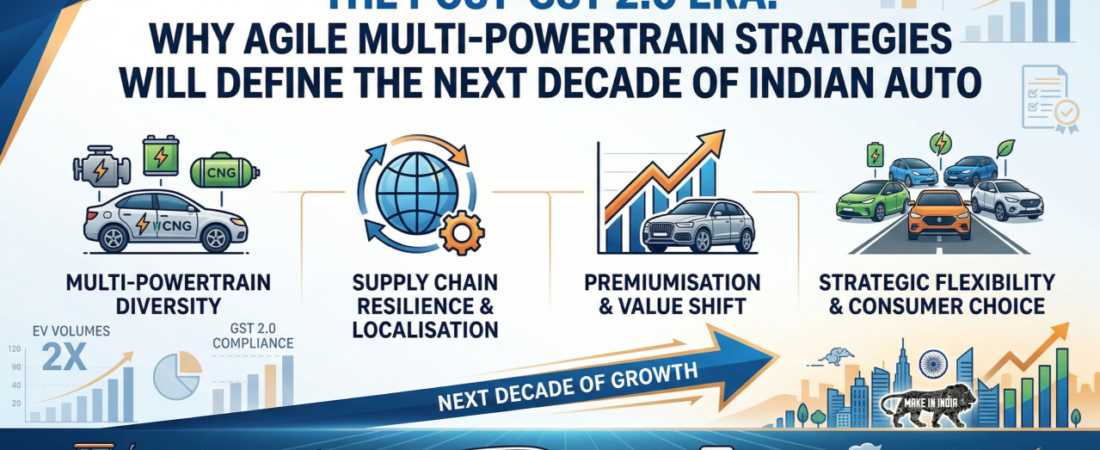
The Indian automotive landscape has just closed a landmark FY26, hitting record volumes of 4.7 million units. But as we look toward FY27, the headline isn’t just about the “recovery”—it’s about the strategic divergence between those stuck in a single-segment mindset and those building resilient, technology-agnostic ecosystems.
Having navigated the complexities of export markets and large-scale operations, I believe we are entering an era where “Execution Velocity” and “Agile Compliance” will be the only true competitive moats.
1. The “Dual-Engine” Growth Model: Beyond the EV vs. ICE Debate
The recent performance of industry leaders proves that success today requires a multi-front strategy. Mahindra & Mahindra, for instance, has successfully built a dual-engine growth trend led by SUVs and three-wheelers, nearly reaching the 1 lakh monthly sales milestone in March 2026. Simultaneously, consumer preference for greener technologies is accelerating, with CNG volumes growing by 20% Y-o-Y and EV volumes crossing the 200,000-unit milestone. Leadership in this environment isn’t about picking a single winner; it’s about managing a transition while maintaining the “power of choice” for the consumer.
2. Navigating Geopolitical Headwinds with Supply Chain Resilience
We cannot ignore the geopolitical volatility in West Asia, which is creating direct cost pressures and impacting export shipments. Strategic leaders must now prioritize:
- Deep Localisation: To reduce reliance on imports, particularly for critical EV components, India is aggressively pursuing “Rare Earth Corridors” and magnet schemes to secure the supply chain.
- Operational Hedging: Diversifying export portfolios across multiple geographies is essential to offset regional volatility. For instance, the push for “Make in India, Make for the World” has enabled record-breaking exports of 4.47 lakh vehicles this year, supporting national economic resilience.
3. The Shift from Volume to Value: The Premiumisation Wave
The data is clear: while the entry-level segment faces pressure from rising input costs , the premium SUV and LCV segments are booming. In the LCV space, we are seeing a structural shift toward higher-tonnage vehicles and value-driven strategies centered on driver comfort and total cost of ownership rather than just purchase price.
The Path Forward
The leaders’ task is to move beyond reacting to quarterly dispatches. We must build organizations that are Technologically Agnostic and Operationally Resilient. Whether it is scaling electric commercial vehicles to meet CAFE-2 norms or leveraging India’s cost competitiveness to become a global hub for metal forming, the goal remains the same: creating products that “wow” the customer while building a business for perpetuity.
The next three years will decide the next thirty. It’s time to lead with vision, not just volumes.