Across industries, modern leadership is evolving beyond traditional productivity metrics. Reflecting on Gallup’s latest global workforce data, the biggest strategic opportunity for organizations today isn’t just managing turnover—it’s actively unlocking human potential and fostering psychological safety.
Here are a few thoughts on why silence can be an invisible cost in large organizations, and how strategic leadership can solve it 👇
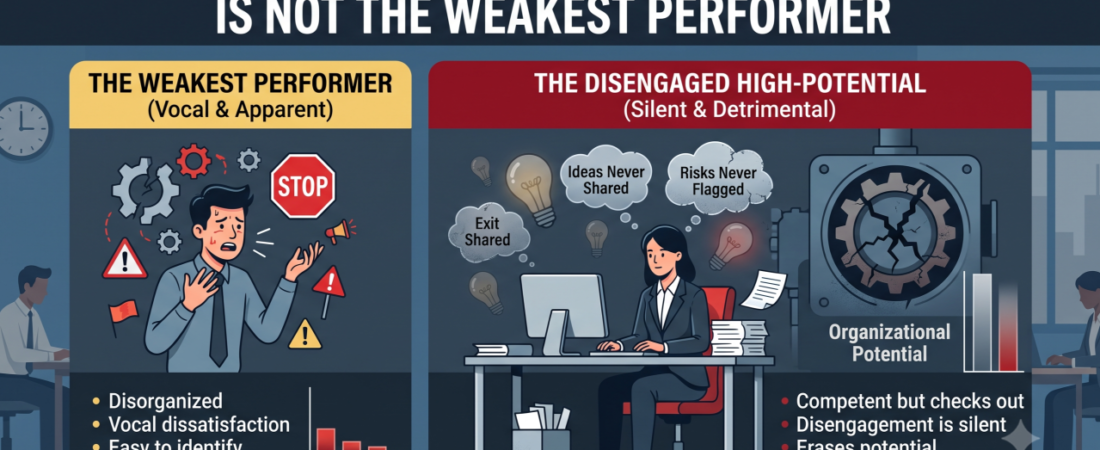
The most dangerous employee in your organization is not the underperformer.
Every leadership team worries about poor performers—they track them, performance-manage them, or exit them. Almost no one worries about what happens when high performers quietly stop caring.
Yet that single, unnoticed shift is where great companies silently begin to decline.
The Corporate Myth We Need to Challenge
Most organizations invest millions in identifying high potentials, mapping succession plans, and cultivating top talent. Yet very few pay attention to a far more critical metric:
How many formerly committed, high-value employees have emotionally checked out?
They haven’t resigned. They aren’t complaining. They aren’t protesting or causing disruption. They are simply sitting at their desks, quietly doing the bare minimum.
Because disengagement is rarely loud. It is silent—and silence is extraordinarily expensive.
The Numbers Every Leader Should Know
Global workplace research paints a bleak picture of this reality:
Global Engagement is Broken: According to Gallup research, only 21% of employees globally are engaged at work, leaving nearly 4 out of 5 workers either disengaged or actively disengaged.
The Trillion-Dollar Leak: Falling engagement accounts for an estimated $438 billion to trillions in lost productivity globally each year
The Manager Factor: 70% of the variance in team engagement is directly influenced by the manager.
The biggest productivity challenge facing modern enterprise is not market competition or technological disruption. It is the vast pool of human potential already sitting inside the building that has simply been turned off.
The Invisible Balance Sheet: The Cost Nobody Measures
On paper, a disengaged employee looks fine. They log on at 9:00 AM, submit their reports, attend their meetings, and check off their deliverables. To HR and executive leadership, the business appears stable.
But off the official record, the balance sheet reflects something else:
| THE INVISIBLE BALANCE SHEET |
|---|
| VISIBLE (On Paper) | INVISIBLE (The True Cost) |
|---|---|
| Task Completion | Ideas Never Proposed |
| Meeting Attendance | Risks Never Flagged |
| Report Delivery | Innovations Never Built |
| Predictable Output | Standards Never Defended |
The issue is not basic output—it is unused capability. And unused capability never shows up on an MIS report.
How Silence Destroys Companies: Three Cautionary Realities
1. The Engineer Who Stopped Speaking
A manufacturing firm spent months investigating persistent product quality failures. Millions were spent reviewing machinery, supply chains, and external vendors.
Later, leadership discovered a senior engineer had identified the exact defect nearly a year earlier. He had raised the issue twice, was brushed off, and concluded that speaking up created friction without driving change.
So, he stopped speaking. The expertise was in the room, but the culture muted it.
2. Market Blindness from the Inside Out
When major market shifts occur—whether Nokia missing the smartphone revolution or legacy banks failing to anticipate fintech—outsiders often assume leaders simply “didn’t know.”
In reality, internal teams almost always flag the danger years in advance. The failure isn’t intelligence; it’s the lack of psychological safety required for uncomfortable truths to travel upward. When employees realize leadership rewards confirmation over candor, they stop trying to steer the ship.
Why Smart People Stop Caring
Top performers do not disengage overnight, and they rarely do so over salary or workload. They stop caring when they experience a series of subtle cultural breakdowns:
- Speaking up creates personal risk: Challenging a bad decision is treated as non-alignment rather than high ownership.
- Decisions are made before the meeting: Input is requested for illusion, not influence.
- Excellence and mediocrity receive equal reward: High effort is met with more work; low effort is met with lower expectations.
- Initiative leads to bureaucracy: Proposing an improvement brings three extra committee meetings instead of resources.
At that critical moment, a shift occurs: The employee stays, but the owner leaves.
The Strategic Leadership Test
The distinction between conventional management and true strategic leadership lies in the questions being asked.
Traditional Management Asks:
“Why are people leaving us?”
Measures: Turnover & Attrition
Focuses on: Visible Departures
The same questions what traditional management asks are asked differently by Strategic leaders:
Strategic Leadership Asks:
“Why are talented people staying, but no longer contributing at their full potential?”
Measures: Voice, Trust, & Initiative
Focuses on: Invisible Disengagement
Turnover is a lagging indicator. By the time revenue falls or high performers resign, disengagement has usually been compounding for years.
The Hard Truth: Re-defining Leadership
Culture is not revealed by how a company treats its best performers when they agree. Culture is revealed by what happens when an employee challenges the status quo.
Do leaders get defensive, or do they listen? Do they reward conformity, or do they encourage truth?
The next generation of leaders will not be judged merely by market share, headcount, or short-term revenue spikes. They will be judged by a far harder standard: How much human potential were they able to unlock?
Strategy is not forged in executive retreats. Strategy happens when ordinary employees feel safe enough to solve extraordinary problems.
The Double Departure
People leave organizations twice:
First, emotionally.
Then, physically.
The smartest leaders don’t wait for the second departure to show up on an exit interview. They learn to spot the quiet, early retreat of belief and ownership long before it turns into a resignation letter, because they understand:
“Disengagement doesn’t fail a company through action—it fails it through silent inaction.”
What’s your take on this? Do share your thoughts in the comments below.
#Leadership #Culture #StrategicLeadership #FutureOfWork #PeopleStrategy #EmployeeEngagement #OrganizationalHealth #ThoughtLeadership